My start off point here will be the VIetnam war, Tactical air Reconnaissance has a much deeper and longer history that the one that I will portray here on my website. I will explain the history in seperate chapter.
Vietnam War
The SR-71 Blackbird and other strategic reconnaissance platforms flew in Southeast Asia, but the information they collected was geared mostly to the needs of the national intelligence agencies. For dayto-day targeting information and bomb damage assessment, 7th Air Force relied on its own tactical reconnaissance aircraft.
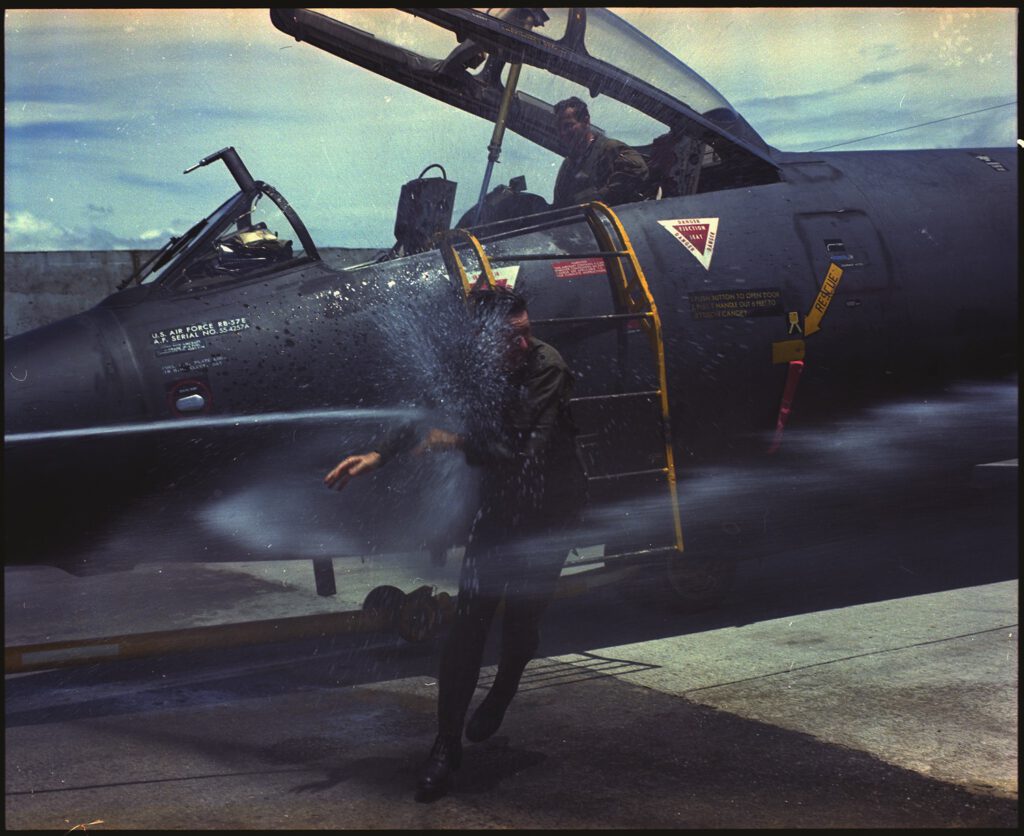
The RF-101C Voodoo, which had flown low-level reconnaissance missions during the Cuban Missile Crisis, was the workhorse in the early years in Vietnam. From 1967 on, RF-4Cs took over most of the tactical reconnaissance jobs in Southeast Asia. Both the RF-101 and the RF-4 were variants of fighters, but they had significantly longer noses to house their cameras and electronic equipment. The RF-101 collected the photographic intelligence required for air strikes against North Vietnam, which began in February 1965. To get pictures of the SAM sites, the RF-101s came in low and fast, popped up for the film run, then dived back down for the getaway. They were faster than the MiG-17s, but not as fast as the MiG-21s.
The RF-4C, a better match for the MiGs, began flying the missions in the North, and the Voodoos were employed in Laos and South Vietnam until their service in the war ended in 1970. Thirty-three RF-101s were lost in combat. The RF-4C packed cameras, mapping radar, and infrared imaging equipment. It had a number of innovative features, including an ejectable film cassette, but that did not work well in Southeast Asia, where the standard procedure was fast film processing when the airplane landed. RF-4C cameras had good resolution at high altitudes, but weather and the triple canopy jungle tended to keep the operations lower to the ground. The aircraft continued to fly missions over North Vietnam, typically without escort. Seventy-six RF-4Cs were lost in combat in Vietnam, most of them to antiaircraft artillery, but none were shot down by MiGs. The RF-4C set the standard for aerial photo reconnaissance and was still in service for the Persian Gulf War in 1991
Early USAF Reconnaissance in Southeast Asia
The first USAF missions in the Southeast Asia War were reconnaissance flights. These top-secret flights confirmed communist activity in South Vietnam and Laos and led to greater U.S. involvement in Southeast Asia.
Reconnaissance forces are among the first to be engaged in most i conflicts and Southeast Asia was no exception. U.S. Air Force recce began their chapter in January of 1961 with an SC-47 which was withdrawn from operations along the Korean Demilitarized Zone (DMZ). 3 This aircraft was deployed to Vientiane, Laos, to support U.S. Air Attache (AIRA) aerial reconnaissance efforts over Laos. It has a I K-38 camera (24″ or 36″ focal length) and a 100′ long-range oblique camera. After 38 successful sorties, the SC-47 was shot down over the Plaine des Jarres in central Laos on 24 March 1961.
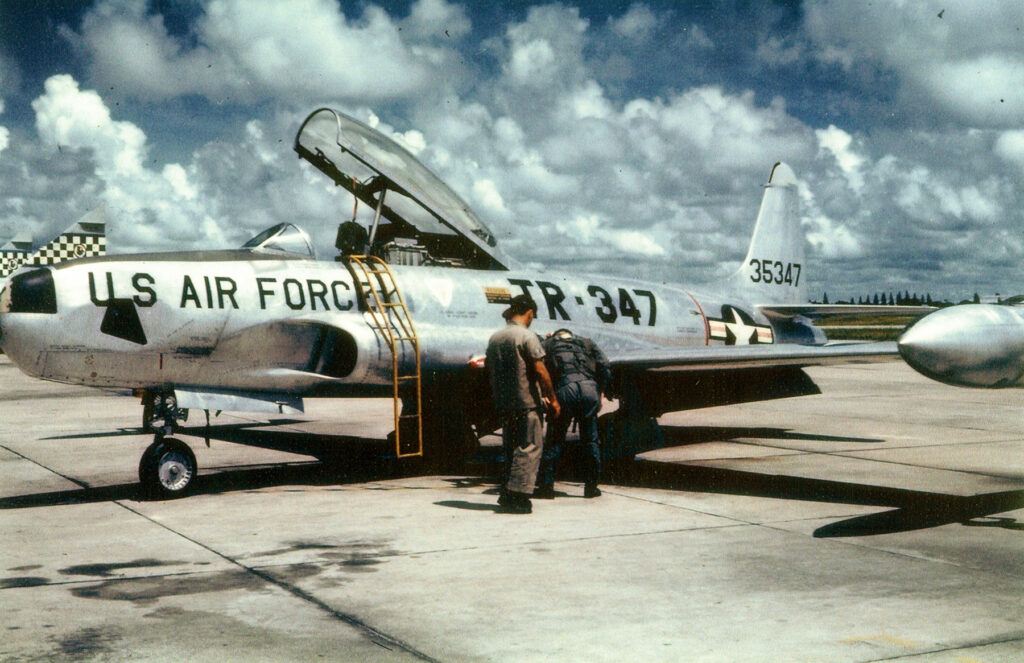
A camera-equipped C-47 flew the first missions until it was shot down by anti-aircraft fire in March 1961 (killing all but one aboard). The USAF then used an RT-33A under the code name PROJECT FIELD GOAL and later fast, highly-capable RF-101Cs under the code names PIPE STEM and ABLE MABLE.
FIELD GOAL
After the loss of the SC-47, an RT-33, received from the Philippine Air Force, was sent to Udorn Air Base, Thailand. This operation, directed by 13AF OPLAN 203-61, dated 16 April 1961,(nicknamed FIELD GOAL) provided reconnaissance of Laos and Thailand for the U.S.Country Team in Laos from April to November of 1961. Toward the end i of the period, a second RT-33 was received and moved to Don Muang Air Base, Bangkok. A combined team was recruited from the 15th and the 145th TRS’s and consisted of Captain Whitten and Lieutenant’s Linihan, Muesegaes, and Weatherby.
PIPE STEM
During the Autumn of 1961, increased Communist activity in South 3 Vietnam indicated a need for additional reconnaissance. An “air show’ came to Tan Son Nhut Air Base, Saigon, South Vietnam, and included four RF-101’s (Voodoo’s). When the “air show’ left, the Voodoo’s remained to provide the first in-country based jet reconnaissance. ! A cover story indicated they were “providing the Vietnamese Government 3 with photographic reconnaissance of flooded areas in South Vietnam.” A Reconnaissance Task Force (RTF) (nicknamed PIPE STEM) consisting 3 of four RF-101’s and a Photo Processing Cell (PPC) was deployed to Tan Son Nhut from the 15th Tactical Reconnaissance Squadron (TRS), Kadena Air Force Base, Okinawa. Initial personnel arrived 18 October1961 and first sorties were flown 21 October. The Vietnamese Air Force (VNAF) provided office and maintenance space, some supplies, and an average of five or six photo interpreters each day. On 23 October, PIPE STEM crews obtained photography of the paradrop on Tchepone Airfield in Laos. Reportedly, this photography was sent to the President. The RTF was originally scheduled for only eight days of operations; however, it was extended to fulfill additional requirements. Sixty-seven sorties over both South Vietnam and Laos obtained mosaic coverage of suspected Viet Cong areas and border infiltration routes. The 3 first RTF returned to Kadena on 21 November 1961
FARM GATE
RB-26 aircraft were used for many different missions in Southeast Asia. The first was with FARM GATE, a project which arrived in South Vietnam on 5 November 1961 to train Vietnamese Air Force (VNAF) personnel and to develop concepts of counterinsurgency. In the spring 3 of 1962, eight T-28’s, four SC-47’s, and four RB-26’s were stationed at Bien Hoa Air Base, South Vietnam. The RB-26’s flew attack as well as visual and photo reconnaissance and, by 12 April, had 64 operational 141 sorties to their credit. In addition to K-17C cameras for vertical and oblique photography, there were gun cameras and K-20 cameras for 3 hand-held photography. A small PPC with capability of about 1500 feet 15/ of film per day was established.
BLACK WATCH
When Communist activity in Laos increased in May 1962, PACAF decided to adapt the RB-26’s to provide a night recce capability for that country. All the FARM GATE RB-26’s carried cameras but needed rewiring for night photo and infra-red operations. Two were sent to Clark Air Base, Philippines, for modification. While being reconfigured in May 1962, they were replaced by two from Kadena marked with the aircraft numbers of the original FARM GATE planes. The two modified aircraft were deployed to Don Muang and placed under operational control of the ABLE MABLE commander. Here they performed BLACK WATCH missions – night recce of Laos. Between 29 May and 29 July 1962, these two RB-26’s flew 50 such missions. After the Laotian cease-fire agreement was reached, the BLACK WATCH aircraft returned to the FARM GATE operation at Bien Hoa.
PATRICIA LYNN
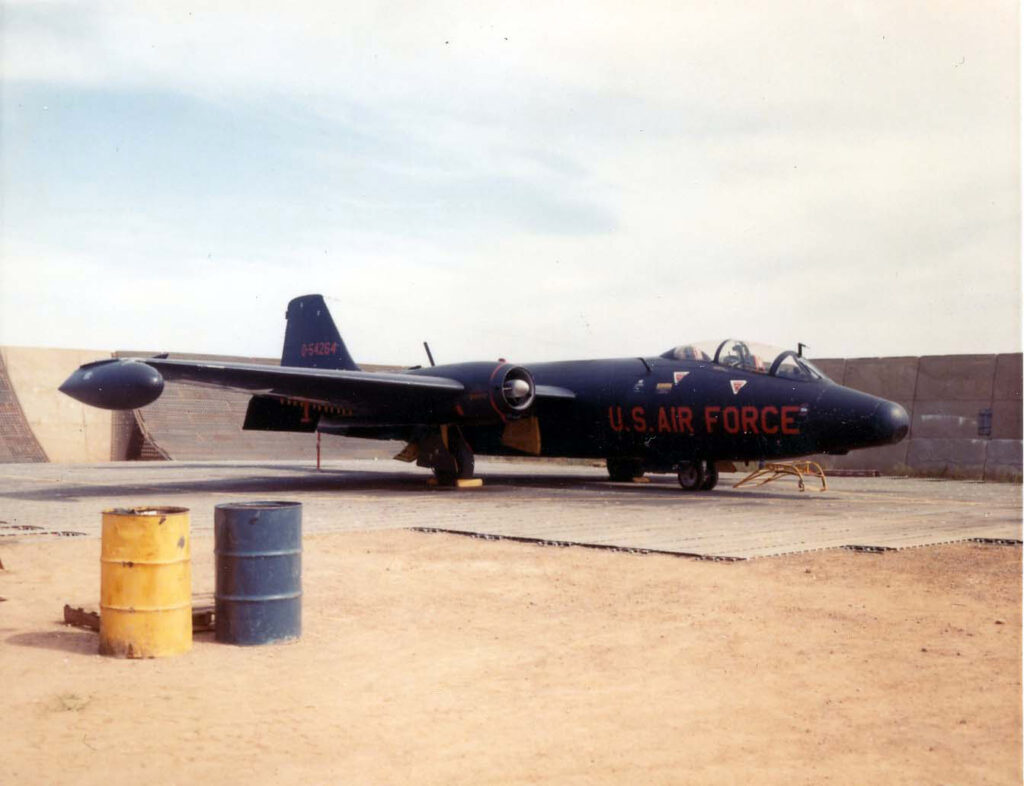
Building on the foregoing experience, on 15 April 1963, two RB-57E’s, the first RB-57 types in Vietnam, were sent to Tan Son Nhut and nicknamed PATRICIA LYNN. This addition was welcome, indeed, since it provided an improved (Reconofax VI) and continuous infra-red capability in-country. In the past, this coverage was intermittent because it required out-of-country maintenance. IR was of vital importance in Southeast Asia where the enemy used the cloak of darkness to conceal his operations. In addition, the RB-57E would add to the day-photo capability by providing a higher-altitude, longer-range recon platform with the latest panoramic camera equipment. Since the B-57 was a jet bomber type and, therefore, politically sensitive, the U.S. Ambassador was asked to concur in its introduction to the theater. Since the PATRICIA LYNN mission and the RB-57E configuration were strictly reconnaissance, the Ambassador approved. Though there were only six PATRICIA LYNN RB-57Es — and two of these were shot down–their effectiveness far outweighed their numbers. Flying under the radio call sign Moonglow, RB-57Es remained in heavy use until the PATRICIA LYNN program ended in 1971.
GREEN PYTHON
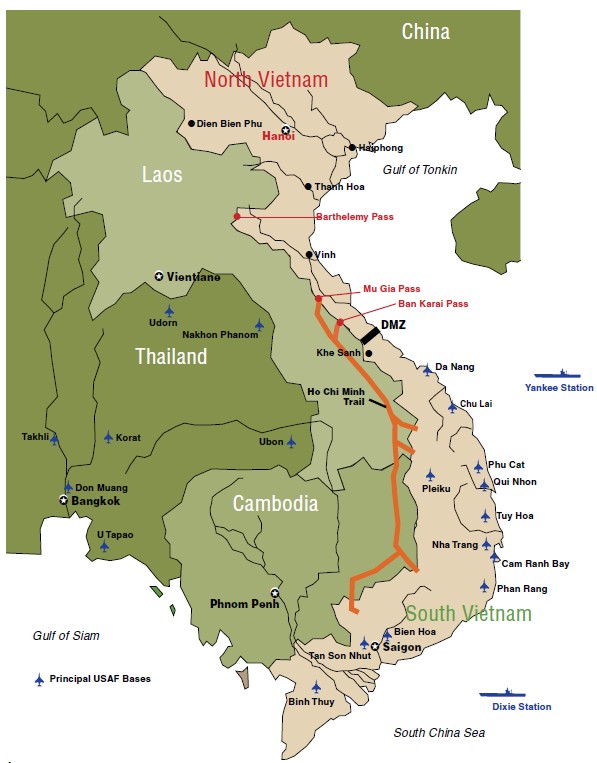
The reconnaissance of Laos and North Vietnam, under projects YANKEE TEAM and BLUE TREE, generated a need for more recon aircraft. In South Vietnam, air bases were overcrowded and vulnerable. In addition, the difficulty in reaching targets in Northern Laos and Vietnam from these I bases led to considerable discussion of establishing a recon base in Thailand. In April 1965, six RF-101s were deployed from Kadena Air Base, Okinawa, to Udorn Royal Thai Air Force Base, Thailand, to establish project GREEN PYTHON. These aircraft had initially deployed from TAC in August 1965. GREEN PYTHON mission was to provide day photographic and visual reconnaissance in Laos and North Vietnam, as directed by 2AD. Concurrently, eight additional TAC RF-101s were sent to Kadena to maintain the force level. However, the next mouth six more of these Voodoo’ s were flown to Udorn giving the GREEN PYTHON force a total of twelve. These TAC planes were a mixture of standard camera system (KA-2) and low-level 1181 configuration developed from TOY TIGER (KA-45). PACAF RF-101’s were undergoing modification to the 1181 configuration (KS-72, KA-57 Panoramic) with completion scheduled for August 1965., Udorn and Tan Son Nhut became the two major reconnaissance bases in Southeast Asia. For the day-visual and photographic recon the RF-101’s took the load.
There was a natural division; ABLE MABLE (Det 1 at Tan Son Nhut) took the in-country missions (some nearby out-country) and GREEN PYTHON (then the TAC aircraft at Udorn) took the out-country missions. In November 1965, the 15th TRS from Kadena took over GREEN PYTHON responsibility. At the same time, the 20th TRS acquired the twelve RF-101’s of Det 1 at Tan Son Nhut. This led to difficulty since targets in the heartland of North Vietnam were heavily defended and the Udorn operation, consequently suffered heavy losses. Additionally, there was the problem of rotation attrition in that Udorn crews were quickly amassing 100 NVN mission credits. In April 1966, the 20th TRS moved from Tan Son Nhut to Udorn, and the 45th TRS moved to Tan Son Nhut.
In May of 1966, an additional four RF-101’s were sent to augment 1the 20th TRS at Udorn. In July, the 45th TRS at Tan Son Nhut was due to receive an additional four aircraft and become a TRS instead of an RTF. This would mean that, as of December 1966, there would be 32 RF-101’s in SEA (sixteen with the 45th TRS at TSN and sixteen with the 20th TRS at Udorn).
On June 1964, Det 2, 35th Tac Op, had been established at Udorn and an RTF of six RF-101’s with a PPC had been proposed. When the Voodoo’ s arrived the PPC was activated. In November 1965 it became Det 1, 13th RTS, with the mission to process film, make select prints and write IPIR’ s on photography by aircraft recovering at Udorn. By June 1966 they were processing approximately 570 missions each month. Its busiest day was 30 June 1966, the day after the first raid on the Hanoi POL storage, when 45,76 9 feet of film were processed. The Hanoi POL raid of 29 June 1966 provides an excellent example of reconnaissance in North Vietnam. Sorties were directed to fly into the restricted zones around Hanoi and Haiphong and bomb major POL storage and transshipment areas. The Navy was assigned Haiphong; the Air Force, Hanoi. Because of the Presidential-level commitment to avoid unnecessary civilian casualties, the exact target location and boundaries had to be known to permit the bombers to “surgically” destroy the target without collateral damage. ELUE SPRINGS, a C-130 launched reconnaissance drone, provided the pictures for detailed target study. On the evening of 28 June, the “Frag” assigning the missions was published. Weather reconnaissance flown early on 29 June found weather conditions marginal but improving. The waitingF-105 strike force was delayed until the weather cleared, then launched. Major Hallett P. Marston, also with the 20th TRS, who had flown in Korea and over Cuba during that crisis, was assigned the EDA mission following the strike. Alerted by the waves of F-1O5’s, the flak was intense and accurate from three minutes before target until two minutes after. He made one pass by the target, obtaining nose oblique photography as he approached, then panoramic (K-56) coverage as he banked the airplane and passed the target. It was an oblique shot (frame 028 of mission UE 901F, 460 TRW) which received worldwide publicity.
RF-4C era
For the Phase I buildup, which followed the Secretary of Defense’s July 1965 visit, it was decided to provide the most modern reconnaissance aircraft in the USAF inventory. Implementing that decision, the 16th Tactical Reconnaissance Squadron, with RF-4C’ s, was brought to Tan Son Nhut. The first increment of nine aircraft arrived in October 1965 and the second nine in December. For Phase ITA, ten RF-4C’ s arrived at Udorn, Thailand, in July 1966. They were designated the 6461st TRS. When they are joined by 14 additional aircraft in October, the entire unit will become the 11th TRS with 24 RF-4C’s. In addition, the 12th Tactical Reconnaissance Squadron, with 18 RF-4C’s, was due at Tan Son Nhut in August 1966.- Thus, by October 1966, the SEA RF-4C structure would show two 18-aircraft squadrons, the 16th and 12th Tactical Reconnaissance at Tan Son Nhut; and one 24-aircraft squadron, the 11th Tactical Reconnaissance at Udorn. That would mean 60 RF-4Ct’ s Iin theater. In addition to the high-performance characteristics of the aircraft, the special reconnaissance features include the more modern infra-red system, the side-looking radar (SLR), and the forward 501 3 looking radar (FLR).- (See Appendex C, “Data on Basic USAF Reconnaissance Equipment in SEA”, for details.) Although the AN/AAs-18 IR Iis the most modern in USAF’ s SEA inventory, it still is necessary to fly at low altitudes for good resolution. The FLR presents the terrain ahead of the aircraft and permits the pilots to fly low altitudes more safely, especially at night. Because of the quality of the IR and I this FLR feature, more IR photography (called RED HAZE) is now flown by RF-4C’s. While the Phantom has an AN/APQ-l02 SLR, it has not been used frequently in SEA. The side-looking airborne radar (SLAR) of the Army Mohawk, the OV-lB, has generally performed this function; however, the RF-4C SIR is the only all-weather, day or night reconnaissance in SEA. The RF-4C also has a photo-flash capability, but heavy moisture content of the air and dense foliage in SEA decreased the altitude from which it can be effectively used.
PHYLLIS ANN
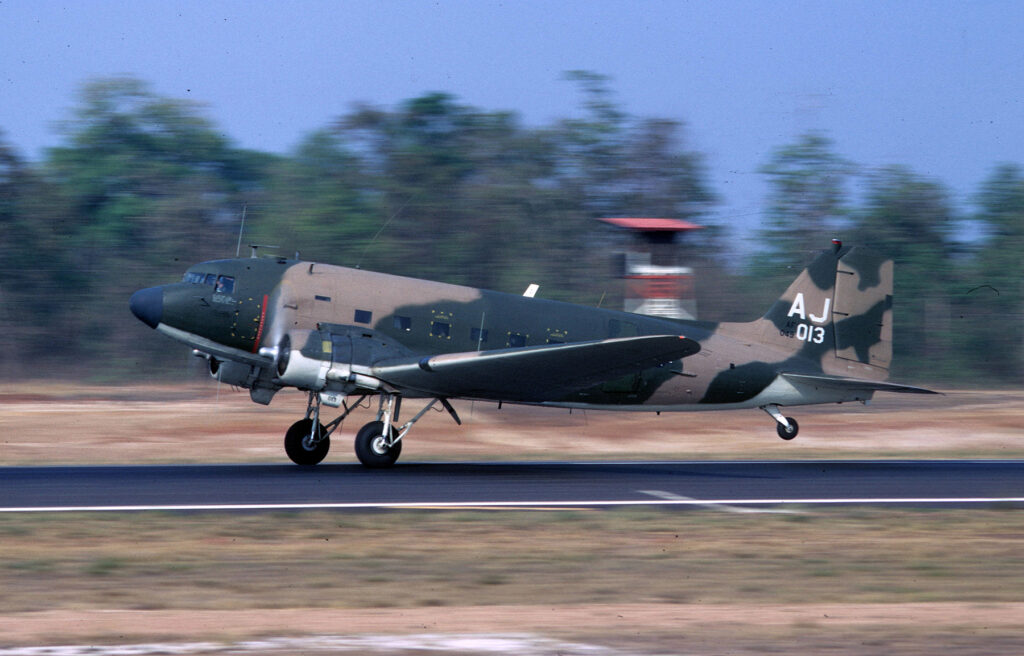
In January 1966, MACV stated a requirement for an additional 1256 hours of AREF per 66/ week. The MACV plan for this increased program would utilize U-6 and U-8 aircraft. The Air Force plan would employ the C-47. PACOM appeared ready to accept MACV’s position and request only U-6/U-8 aircraft, when an Air Force briefing of CINCPAC stressed the advantages of the improved C-47 program.- The Army aircraft used aural null techniques which required the I plane to fly a pattern (which might reveal its mission) during which transmission had to be sustained. The C-47 ARDF program used Phase Ange Discrimination (PAD), which took angle measurements automatically in less than one second. PHYLLIS ANN, the improved C-47 program, included side-calibration so that fixes could be obtained in any I direction without turning the aircraft. Thus, the mission was not compromised and the “quick shut-down” transmitter could be detected. CITCPAC the C-47 program and USAF stated that “this I program is of the utmost importance to USAF and requires extraordinary 68/ action by all organizations and personnel concerned”. In March 1966, USAF directed 35 additional C-47′ s added to the one in place.
In April, the 360th Reconnaissance Squadron was assigned to Tan Son Nhut. The first RC-47 arrived in May with the full quota of 17 programmed to be in place by September 1966. The 361st Reconnaissance Squadron was assigned to Nha Trang. The first aircraft was to arrive in July 1966, and a strength of nine to be attained by September. Detachment 1 of the 361st, with nine RC-47’s, was to be based at Hue Bai. The plan, as of July 1966, was to have the 17-plane 360th Reconnaissance Squadron at Tan Son Nhut; a 15-plane 361st Reconnaissance Squadron at Nba Trang; and, Detachment 1, 361st Reconnaissance Squadron at Pleiku with an additional 15 planes. In view of the compromise of effectiveness resulting from publicity of RED HAZE, special effort is being made to prevent disclosure of the PHYLLIS ANM mission.
Units involved in the Vietnam War
At the end of 1968, the 460th TRW at TSN had 36 RF-4s in two squadrons, 16 RF-101s in one squadron, and two RB-57s assigned to a Wing detachment. The sister Wing, the 432d TRW at Udorn, constituted the only mixed fighter/reconnaissance Wing based on mainland SEA. The 11th TRS (Road Runner) and the 14th TRS (Photo Phantoms) were equipped with 20 RF-4C aircraft each. The SEA structure appeared as follows;
460th Tactical Reconnaissance Wing
- 12th Tactical Reconnaissance Squadron (TSN)
- 16th Tactical Reconnaissance Squadron (TSN)
- Det 1, 45th Tactical Reconnaissance Squadron (TSN)
- 360th Tactical Electronic Warfare Squadron (TSN)
- 361st Tactical Electronic Warfare Squadron (Nha Trang)
- 362nd Tactical Electronic Warfare Squadron (Pleiku)
- Det 1, 460th Tactical Reconnaissance Wing (TSN)
- 460th Reconnaissance Training Squadron (TSN)
432nd Tactical Reconnaissance Wing
- 11th Tactical Reconnaissance Squadron (Udorn)
- 14th Tactical Reconnaissance Squadron (Udorn)
- 553rd Reconnaissance Squadron (Korat)
- 554th Reconnaissance Squadron (Korat)
- Det 1, 553rd Reconnaissance Squadron (Nakom Phanom)
- 41st Tactical Electronic Warfare Squadron (Takhli)
- 42nd Tactical Electronic Warfare Squadron (Takhli)
The expansion and growing sophistication of Air Force tactical reconnaissance between June 1966 and the early months of 1969 did not in themselves resolve all organizational problems. It soon became apparent that the requirements of in-country operations differed sharply from those of Laos, North Vietnam, and other out-country areas which might be involved in the SEA conflict. While in every case, the principal objective was the supplying of information as rapidly as possible to customers, the types of information desired not only caused considerable difficulties themselves, but led to severe interservice disagreement.
This conception of in- and out-country reconnaissance programs, each with wet and dry seasons, only very roughly approximates the reality, especially when the 1968 bombing halt markedly reduced the reconnaissance requirements over the North. RF-4s based at Tan Son Nhut often flew out-country photo missions and, conversely, out-country reconnaissance assets supported in-country requirements. The latter aircraft did not fly in-country but rather covered a strip of Laos about 20 miles deep along the South Vietnamese Border. COMUSMACV and ground commanders in I and II Corps wanted detailed intelligence on enemy I operations in this extended battle area. According to reconnaissance personnel at 7AF, this separation of in- and out-country staff sections did cause some coordination problems along the Laotian/South Vietnamese Border.
The growing threat of SAMs and the increasing number of MIGs on station -during this period prompted emergence of the survivability question in an acute form. The problem, of course, was of concern to planning agencies from the beginning and appears in discussions as early as 1965, when restrictions were placed on reconnaissance flights to avoid the embarrassment of being shot down over neutralist Laos. COMPASS DART aircraft were hit by ground Fire in early missions, and their minimum altitude was raised to 2,000 feet. Four RF-4Cs were lost in January 1967 alone, and after the fourth loss, the Commander, 7AF, imposed several restrictions on photo reconnaissance missions in high-danger areas flights were to be timed to coincide with EB-66s on station time in support of the strike package all daytime photo reconnaissance flights into high-threat areas were-to be in groups of two; maximum use would be made of the RF-4C night capability; until ECM was available, single reconnaissance aircraft would be escorted in very high-threat areas, insofar as practicable, by QEC-180 pod-equipped F-4Cs; under normal conditions 12 to 24 hours would elapse between strike and photo reconnaissance. Further restrictions I were instituted in February 1967. Night photo cartridge missions in dangerous areas were required to exceed 4,000 AGL and infrared missions 3,000 AGL. A minimum photo altitude of 12,000 AGL was to apply on all day NVN targets unless directed otherwise.
Three photo reconnaissance aircraft were lost between 1 February and 1 May. Nevertheless, the dual accompaniment raised the morale, although missions were cramped. Photographic confirmation of the presence of SAMs in the DMZ in mid May induced 7AF to place a FAC in the rear cockpit of RF-4Cs for strikes against SAMs, because of the “increased survivability of higher performance jets over the 0-1 aircraft” in this danger zone. In August, the shooting down of an RF-101 led to an order equipping all 3 reconnaissance aircraft operating within the high-threat area of NVN with two operational ALQ-71 ECM pods, which jammed guidance systems in SAMs and occasionally AAA.
In September, a 4,500 minimum altitude restriction was placed on day reconnaissance missions over North Vietnam as a result of the possible loss of one of the RF-101s on a low level mission on 2 August 1967. A requirement that fighter aircraft escort all reconnaissance aircraft in the high-threat area served to limit missions to two per day by September. The obvious solution to the problem was the development of camera equipment which could shoot adequate photography, while the plane remained at safe altitudes and maintained sufficient speed to reduce the threat of enemy fire. The loss of the four RF-4C aircraft in January 1967 represented 80 percent of all losses of the RF-101s to that date, and in the absence of rapid conversion of tactical reconnaissance to RF-4Cs or something even more maneuverable, attention turned to camera equipment. The losses were attributed to the fact that the installed camera lenses required the aircraft to fly at an altitude of 4,500 AGL during a target run.
By the end of 1968, tactical reconnaissance had reached a plateau in its development in SEA. Aircraft in place, for the first time, remained nearly stable; even the gradual substitution of RF-4Cs for RF-101s was temporarily suspended. The RF-4Cs and EC-47s constituted most of the reconnaissance force structure. In-country operations, as before, emphasized visual reconnaissance and photo reconnaissance by day and infrared by night. The less maneuverable RF-101 was largely confined to in-country sorties, whereas in 1966, it had accomplished more work out-country. Out-country operations, however, showed how flexible the operation must be to accommodate changing requirements. FACs provided most of the VR accomplished and also made striking reconnaissance contributions through the hand-held camera program. As a result of the on-going experimental operation, 225 Asahi Pentax cameras, equipped with pistol grip handles and 200-mm lenses, were purchased for use by in- and out-country FACs – in February. In addition, six cameras were provided for use in the EC-47 operation. The acquisition of these cameras increased the capability of the program approximately 500 percent. The information gained by the hand-held camera program ranged from BDA to pictures of equipment and supplies awaiting transshipment. It was very valuable overall, and provided the Air Force with an ability to “secure good timely photo coverage of many items of interest which would otherwise be lost.
Deactivation of the 460 TRW
On 27 July 1971, the 460 TRW at Tan Son Nhut terminated its operations in SEA and subsequently relocated to COMUS. The Wing’s RF-4C squadron, the 12 TRS, stood down from operations late in July to prepare for deployment to the squadron’s new home at Bergstrom 12, AFB, Texas. Other elements of the 460 TRW were also preparing to relocate. The three RB-57Es of Detachment 1, which had served in SEA since 1966, were being readied for transfer to CONUS in late August. The long and productive career of the RB-57s in the Air Force’s reconnaissance inventory appeared to be ending since they were scheduled for deactivation and storage at Davis-Monthan AFB, Arizona
The rest of the Wing, including its personnel and equipment, were 3 being reassigned as the needs of the service dictated. The WS-430B PPIF had already closed down in early July. Its photo interpreters and laboratory technicians were reassigned to the 12 RITS, where they continued to do first-phase IPIR readout for the Wing prior to its stand down. The PPIF itself was also going home, first to the Ogden Air Materiel Area m at Hill, AFB, Utah, for rehabilitation and overhaul. Later it would move again, this time to serve with the Air National Guard units at Meridian, Mississippi and Fort Smith, Arkansas
A SEA mission still remained, however, for the Wing’s TEW squadrons. The three squadrons and their reliable “Gooneybirds” were to remain in place, flying their invaluable ARDF/SIGINT missions in support of SEA-based units. An increasingly important task for the TEW squadrons in the future would be the job of training VNAF flight crews as a part of the program to transfer the EC-47 ARDF mission to the Vietnamese by 1973.
The deactivation of the 460 TRW meant that all SEA photo reconnaissance requirements would be filled by RF-4C aircraft from Udorn RTAFB. The LORAN capability of the Udorn aircraft, together with the KA-82 cameras transferred from Tan Son Nhut Airfield, appeared to insure that adequate photo reconnaissance resources would be available to meet the tactical requirements of the shrinking U.S. force in SEA. Similarly, the continued presence of the 14 PPIF, the 432 RTS and the 12 RITS would provide ample technical I support for all of the remaining photo reconnaissance units. Adequate ELINT support also seemed assured by the 13 EB-66s at Korat, although another dry season campaign might require augmentation of the force. In the end, the future size, composition, and tenure of the reconnaissance force in SEA would depend largely upon political factors beyond the influence of theater reconnaissance managers.