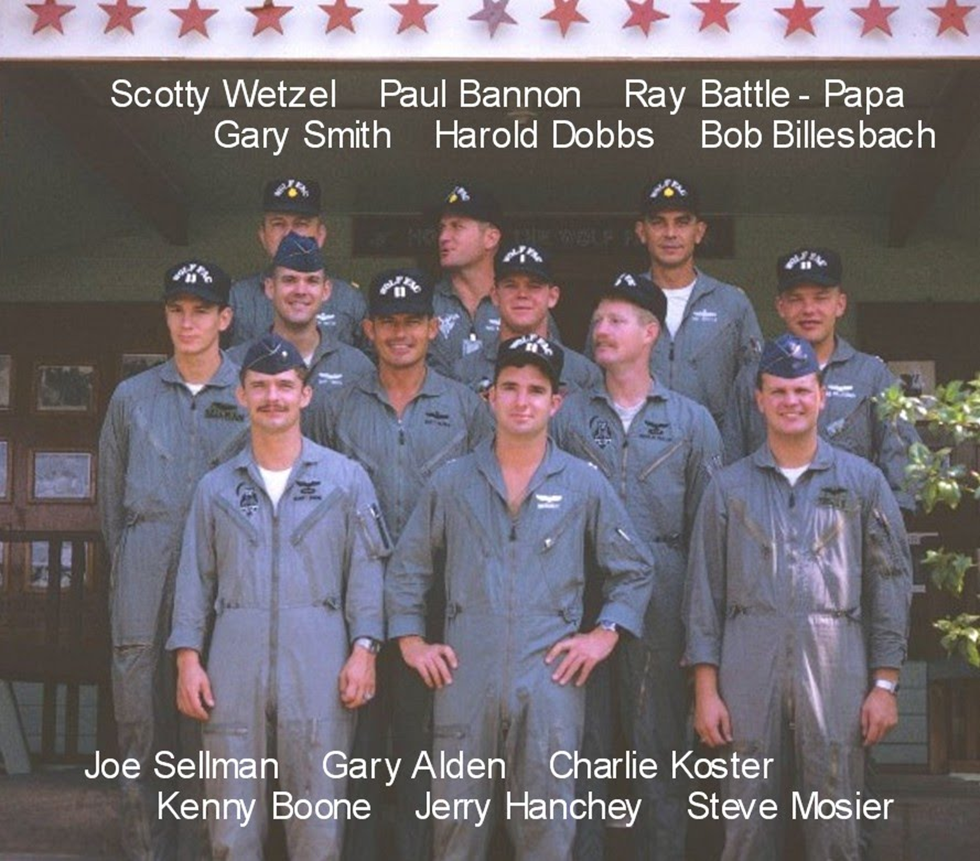
Early in October 1968, Capt. Richard G. Mayo (a Stormy FAC) briefed unit operation officers of the Seventh Air Force at Bangkok, Thailand. As a result, CoI. Slade Nash, head of 8th Tactical Fighter Wing operations, requested permission to employ an F-4D FAC element in his wing. He assured Seventh Air Force the planes were on hand without straining other missions. Specifically, one of the wings squadrons that seeded sensors in Commando Hunt seldom used up its daily allocation of 18 sorties. Authorization was received on 26 October 1968. Benefiting from Misty and Storm experience, the 8th Wing didn’t set up a separate FAC detachment. Instead’ the F-4 FAC Section (called Wolf FAC’s) worked directly under the Operations Division with a status comparable to the wing fighter squadrons. Another innovation was locating the Wolf office in the Intelligence Division to provide a smooth flow of information to the crews. The Wotf FACs had no assigned aircraft but drew them daily from the wing aircraft pool. Maj. Benjamin R. Battle, first WoIf Commander, handpicked every pilot of the first five crews. 11 pilots had to have at least 3 months of out-country combat experience, come highly recommended by their commanders, and be approved by the Deputy Commander for Operations.
Training of the first two crews began on 12 November and bv month’s end five were qualified. Each crewmember took 10 rides in the F-4 Two were in the backseat behind Major Battle (or his operations officer), the remainder in the front seat with an instructor in back. The Wolf controllers received night orientation flights in the 0-2A and C-130 Blindbat.
In December the Wolf forward air controllers commenced flying-3 1/2-hour day missions in Steel Tiger area of operation. The first crew arrived on station early in the afternoon; the second, 2 hours later. Seventh Air Force authorized a third sortie in January 1969 to spread the patrol into the early evening hours. The Wolf F-4D’s added an ALQ-B ECM pod and LAU -3 rocket pod to its inboard stations. For night work, a SUU-42 flare pod (16 flares) replaced the left outboard fuel pod, and a 600-ga11on fuel pod went on the centerline.
The Communists felt the jet FAC’s sting and replied with stepped-up ground fire. Flying below 5, 000 feet quickly became hazardous and fatiguing. The jet controller constantly jinked (pulling 2-3 Grs) during visual reconnaissance. He invited battle damage if he stayed below 4,000 feet very long, doubled back to circle a target, slowed down, or flew a predictable pattern for more than I0 seconds’ Jet FAC’s were accordingly advised to do VR during their first 45 minutes in the area (when they were fresh), then mix the remaining time with VR and strike control.
The soaring demand for Wolf controllers forced the fighter crews to orbit longer, waiting to be brought in. To ease the delay, Seventh Air Force let strike aircraft be their own FACs in areas of the eastern Laotian panhandle free of friendlies. However, the WoIf forward air controller was still required to locate the target and talk things over with the strike leader. He defined cardinal headings in relation to ground features, making sure the target was positively identified and enemy defenses pinpointed. A review of attack procedures followed which the strike leader took charge. This method freed the Wolf FACs for extra VR and strike control.