WHY TWO VERSIONS FOR THE 469TH TFS?
A SHORT QUEST FOR THE TRUTH
By Don Drinnon
March 2014
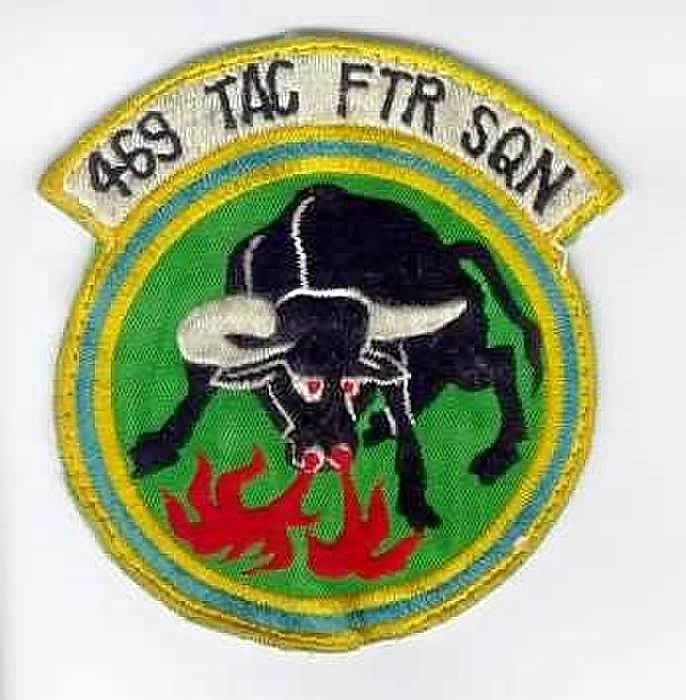
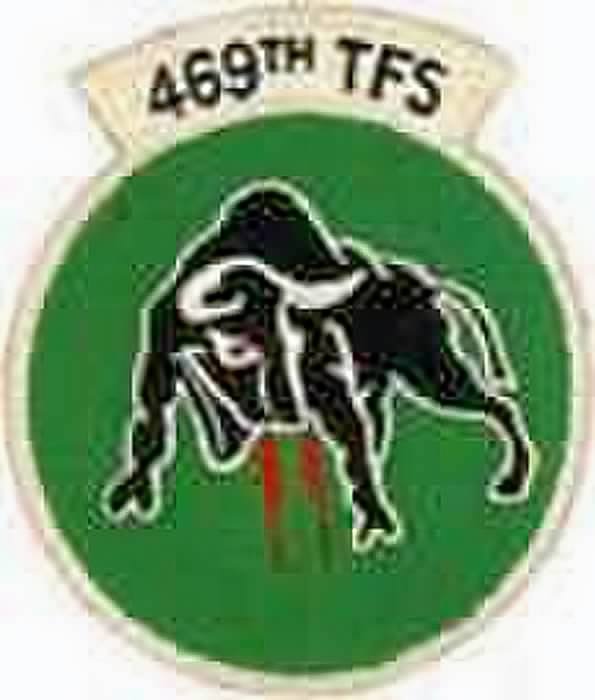
Background: In November 1968, the 40th TFS deployed from Eglin AFB, Florida, to Korat RTAFB, Thailand, with 20 F-4E Phantoms and 57 pilots. This deployment was the introduction of the latest model of the F-4 to the Southeast Asia Combat Theater. Upon arrival, the aircraft and pilots were assigned to the 469th TFS. Previously, the 469th pilots had been flying the single seat F-105D Thunderchief, affectionately called the Thud, and wore the Squadron patch depicted above with a one-eyed fighting bull. The pilots of the new 469th, flying the F-4E, were issued the patch with a two-eyed fighting bull.
I’m not sure when the stories or rumors started, but for the last 45 years we have all heard the stories and rumors about how the Thud pilots changed the squadron patch to ensure that we F-4E pilots didn’t wear their patch. Most of the stories are based on the premise that the Thud pilots did not think F-4E crews would be worthy of wearing the same patch as they did or I’ve even heard that some say that the F-4E crews initiated the change. The one-eyed Thud version was said to symbolize the one seat and/or the one engine of the F-105D, depending upon who is telling the story, while obviously the two-eyed version represented the two seats and two engines of the F-4E.
The Quest: On 28 Jan 2014, I received the following email from Don Bell. D-Bell, as he is known, was a member of the 469th in the 1971 timeframe and also one of the Tiger FACs. D-Bell and I have been communicating for a few years and I have passed him information about our time at Korat. I also assisted in putting him in contact with some of our 1968/1969 guys as a source of information about the origination and early days of the Tiger FAC program. D-Bell has recently published his book, “The Tiger FACs: A Dance with the Devil.” The email from D-Bell:
Don,
As the most knowledgeable of the deployment of the 40th to Korat and the historian of the 469th TFS of merit, I need to ask you a question.
The 469th patch was changed apparently after you guys arrived. The “snort’en one-eyed bull” became a “two-eyed snort’en bull” and the colors were also changed a little. The subject has come up and there is at least one guy, a Ron McGrath, who seems to insist it was redone to honor the back seaters, which he assumes were WSOs and his “teammates”.
I always thought it was simply because the single engine F-105s had a one-eyed bull and the F-4 of course had two engines. There were no WSOs when you guys were there and the back-seaters were all GIBs according to the pictures in the 469th Annual unless I am mistaken.So, who is right? Why was the patch changed? Two engines versus one, or two sets of eyes versus one, or both? What say you? And will we see you at the 22-25 April Reunion in Las Vegas? Hope so.
D-Bell
D-Bell’s email to me started the quest for the truth and I replied to D-Bell that I would try to confirm, what at the time, I believed to be true, that the F-105 guys did it before we arrived.
I decided if anyone had a clue about the change in the patch it would be a member of our advanced party, comprising the seven guys that went to Korat from Eglin a few months early to get a theater checkout and ensure all was set for our arrival in November 1968. I sent a note to Mike Carns, one of the seven, asking him if he knew the truth about the difference in the two patches, did we do it or did the F-105 guys do it?
The next day Mike responded:
The “truth” as I know it is this: I consulted the official USAAF heraldry book and used the patch that was published. I can find that book when I get home and Xerox the pertinent pages…OK?
I replied to Mike as follows:
Thanks, I guess that means one of two things: The Thud guys officially changed it before we got there or the Thud guys were not wearing the correct patch. Wonder which it was. I would like the pages to document them with the some of the history notes that I have.
And Mike replied back:
Again, my memory is as faulty as any 76-year-old but my recollection is that I looked at the Thud 469th patch and noticed that it did not comport with the official USAAF drawings…and procured the right ones…I wasn’t going to mention it to the 105 guys because they were headed out of Dodge…let me look for that book this weekend and I’ll get back to you….
I forwarded Mike’s notes to D-Bell and then said to myself, “what the hell is a heraldry book and did Mike really mean USAAF?”
While waiting for Mike to return home and find the book, I went on-line and researched the heraldry book. I learned more about the patch, which really should be called the emblem, process than anyone would ever need to know, but all the information was current and did not really apply to our question about the approved 469th patch in 1968. I did learn that the patch approval process was very bureaucratic and long and I couldn’t imagine the Thud drivers attempting or being successful in changing the patch while fighting a war. Yes, Mike did really mean the USAAF.
Also, while waiting for the pages from Mike’s book, I sent an email to George Avila, the last Thud driver in the 469th. Many of us met George at our reunion in Florida in April 2013, as he was our guest speaker. My email to George:
George,
Hope this note finds you well.
Would you please refresh my memory on the conversion of the 469th patch from one to two eyes? I recall that the Thud guys did it before we got there. Is that correct and were the two eyes for the two engines, two heads or both?
George’s reply;
Don,
Good to hear from you OMT. As to the patch, the change was not made while I was in Korat. The 469th patches I still have reflect “one eye.” A change may have occurred after y’all rotated in late ’69/’70, or when the squadron designator, 469, became the 469th Flying Training Squadron. The unit is/was located at Sheppard AFB. And, as I recall, primarily trained NATO troops.
Looking forward to SA come Apr, will have my bride along this year.
In the meantime, D-Bell sent a note to the current 388th Fighter Wing historian, Jory Vanderburg, asking for his assistance with our patch history quest since the 469th had been part of the 388th Tactical Fighter Wing at Korat. The 388th is located at Hill AFB, Utah, today, while the 469th is a Flying Training Squadron at Sheppard AFB, Texas, flying the T-38C. This turned out to be a great move by D-Bell as it ultimately led to the truth and the end of the quest.
Subsequently, Mike was unable to locate the heraldry book and determined the book must be still in a box somewhere. He stated that he would be traveling until June and would not be able to continue the search until then. I passed this information to D-Bell and assumed the quest was dead in the water until June. However, Mike did provide a little more detail of his actions at Korat in August 1968.
My recollection, of some years…Korat in August…was that I looked up the heritage in an old USAAF/USAF Book issued by the Air Force (Historical Office???) that explained the heritage and design of the patch. It did not match the Thud patch in several small ways. So, I ordered conforming patches which were given to you guys when you arrived.
Jory came to the rescue while we were waiting for Mike’s box search in June. Jory contacted the Air Force Historical Research Agency to see if they could pull their Archive version of the 469th emblem. Jory’s request for help and the AFHRA contact’s reply follow:
—–Original Message—–
From: VANDERBURG, JORY R GS-11 USAF ACC 388 FW/HO
Sent: Friday, March 14, 2014 12:17 PM
To: REAM, MARGARET E GS-12 USAF AETC AFHRA/RS
Subject: 469th Tactical Fighter Squadron Emblem
Ms. Margaret, I am in need of obtaining an “official” emblem drawing of the 469th Tactical Fighter Squadron Emblem as it existed during the SEA Conflict. The 469 TFS was one of our squadrons at Korat RTAFB. The only exemplars that I have are patches that were made during that time frame.
Please see the attached exemplars; also, please note the differences — particularly the one-eye bull vs. the two-eye bull. Also attached is the current approved emblem/factsheet for the re-designated version, to wit: 469 Flying Training Squadron.
Additionally, do you have any background on the origin of the 469 TFS emblem/patch and why there are the two versions (Eye)?
PS: I recognize that you are out-of-the-office until 17 March.
//Waldo//
Jory R. Vanderburg
388 FW/HO
DSN 777-2920
—–Original Message—–
From: REAM, MARGARET E GS-12 USAF AETC AFHRA/RS
Sent: Monday, March 17, 2014 10:47 AM
To: VANDERBURG, JORY R GS-11 USAF ACC 388 FW/HO
Cc: BRAGG, DAVID L GS-12 USAF ACC ACC/HO
Subject: RE: 469th Tactical Fighter Squadron Emblem
Jory,
The 469th Flying Training Squadron has only two emblems on file: a current emblem that was approved in May 1966, and an historical emblem that was approved in Feb 1955. The current emblem, depicting a two-eyed bull element, was updated into disc format and digitized in Apr 2009.
The one-eyed version of the bull (the image in your .bmp file) is actually the unit’s 1964 draft proposal. The unit submitted the proposal three times for approval, twice being denied because, as it was pointed out to them, the unit already had an approved emblem (i.e., the 1955 emblem). On the third attempt, in Mar 1966, the unit forwarded with its request three Major General endorsements, and, with that, finally succeeded in obtaining approval of the bull emblem, albeit a two-eyed version.
According to correspondence in the unit’s emblem folder, the unit had started using the bull emblem in 1964, two years before its official authorization. And the rendition that the unit used, of course, was the one-eyed bull version. This likely explains the differences in your unit patch images.
For further guidance and assistance, please contact your command emblems
POC, Dave Bragg, DSN 574-4893.
V/r,
//SIGNED//
MARGARET REAM
Historian
AFHRA/RSO
So, there you have it. There was no conspiracy by the F-105 or F-4E pilots. In 1964, the Thud guys started the official process to change the patch from the version used by the 469th Fighter Interceptor Squadron, which had flown F-86D Sabre Interceptors, prior to its deactivation in 1958. They proposed a one-eyed version of a bull in its stance prepared to fight, but a two-eyed version was approved as reflected in the approval letter dated May 1966. The 469th was at Korat in 1965 flying F-105Ds and the 388th TFW was activated on 8 April 1966. Apparently, the 469th started using the design of the patch that was submitted for approval before the final approval was received. They never reverted to the approved design of the patch. When the F-4E advanced party arrived and needed to order patches for its crew members, Mike Carns ordered the approved patches, thus the F-4E crew members had a patch with two eyes.
There’s more!
During the coordination cycle of this document, we received another email with even more clarification from Margaret Ream at AFHRA/RSO.
My apologies to you for not making clear the entity that was responsible for making the change in the unit’s emblem proposal. The decision to change the unit’s one-eyed bull in 1964 to the final official two-eyed bull in 1966 was made by the personnel office at Randolph (AFPMSAU) that handled heraldry at that time. According to our files, all three times the unit submitted the emblem change request, in 1964, 1965, and 1966, the unit was asking for the proposed one-eyed bull version. When the personnel office at Randolph finally accepted the unit’s 1966 request (the one with three major general endorsements), a personnel office staff illustrator refined the proposal in order to improve and enhance its design. This is in accordance with correspondence we have on file. Unit veterans may remember it differently on why two versions exist, but the units emblem folder documents that the switch from the one-eyed bull design to the two-eyed bull design occurred at Randolph as a result of a higher headquarters directed change. See files attached.
Please note that the 1966 letter from the personnel office at Randolph states that the squadron may continue to use the design in its present form (the unit had been unofficially using the proposed one-eyed bull version of the design since 1964) until its supply of patches, stationary, decals, etc., has been depleted; however, when new requisitions for these units are placed, they should contain the design as approved by this headquarters.
Best regards,
Peggy
//SIGNED//
MARGARET REAM
Historian
AFHRA/RSO
One last thing: I am still amazed that a captain fighter pilot knew to go to the heraldry book to ensure that he ordered the correct patch for his arriving squadron. Why didn’t he just ask the F-105 pilots where they ordered their patches? Knowing that Mike is a 1959 graduate of the Air Force Academy, I went to several of my friends, who are Mike’s classmates from the class of ’59, and asked them two questions. Did the AFA teach a class in patches and would they have known to research the heraldry book when they were captains? All responded “no” to both questions.
The quest is now complete. With this off of our plate, I guess we will have to go back to trying to determine which of the eight guys, that claim to have been involved in the lightning strike of the two-ship flight one stormy night over Laos, were really in the four seats.
Below are the three versions of the 469th patch. First is the 1955 approved version for the 469th FIS. Next is the version submitted for approval by the 469th TFS in 1964, 1965, and 1966, and finally the patch that was approved in May 1966.